

CMS vs Static Site vs Frameworks: Which Is the Best Choice for Your Project?
CMS vs Static Site vs Frameworks: Which Is the Best Choice for Your Web Project?
Have you ever stopped to think about the importance of choosing the right solution for your website or web application development? This is a crucial decision that can directly impact the success of your project. After all, it’s not enough to just have an online presence — you need to ensure it’s efficient, scalable, and meets your users’ needs. The choice between CMS vs static site vs frameworks is one of the first and most important steps toward digital success.
In this article, we’ll explore three popular options for building web projects: Content Management Systems (CMS), static sites, and frameworks. Each of these solutions has its own characteristics, advantages, and disadvantages. Understanding the specifics of each will be essential for making the best decision for your business.
Understanding CMS in the Context of CMS vs Static Site vs Frameworks
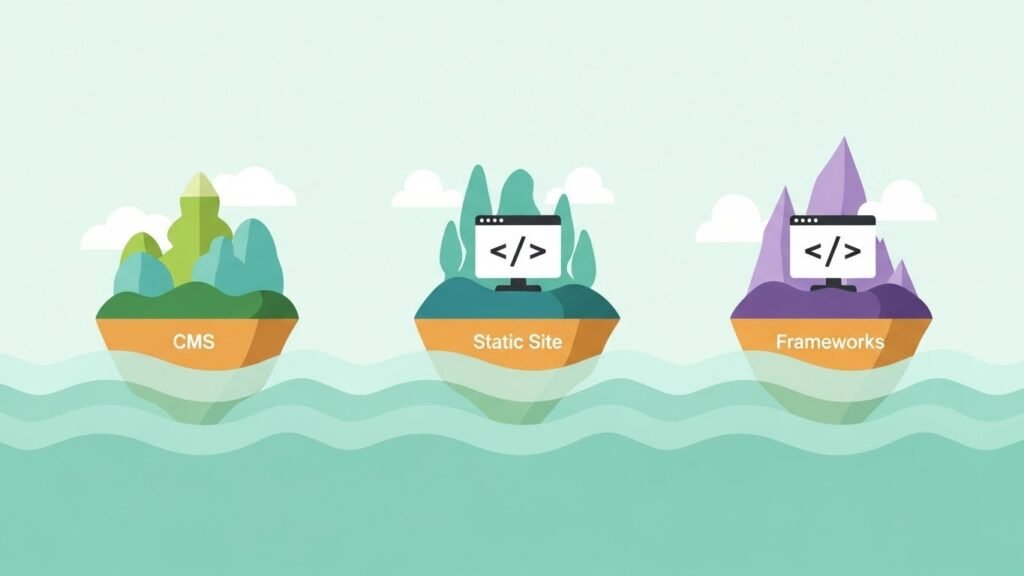
A CMS, or Content Management System, is a software platform that allows for simplified creation, management, and publication of web content. It’s the most traditional and popular option, but how does it compare in the CMS vs static site vs frameworks debate?
- User-friendly admin interface, allowing users without deep technical knowledge to create and update content
- Advanced content management features, such as versioning, publication approval, access control, and SEO
- Ability to extend basic functionality through plugins, themes, and modules
- Integration with databases for information storage and retrieval
Advantages of Using a CMS in the CMS vs Static Site vs Frameworks Debate
One of the main advantages of using a CMS is the ease of use for publishing and updating content. Non-technical users can easily create, edit, and publish pages, blog posts, forms, and much more without needing to deal directly with the source code. In the context of CMS vs static site vs frameworks, the simplicity of CMS for the end user is a major differentiator.
Another important benefit is the scalability that CMS platforms provide. As your site grows in content and functionality, a CMS can keep up with this evolution, offering advanced management features and integration with different systems.
Additionally, CMS platforms also offer built-in SEO tools, making it easier to optimize your content for search engines.
Disadvantages of a CMS
Despite the advantages, CMS platforms also have some disadvantages. One of them is the greater complexity involved, both in initial setup and in system maintenance and updates. Another point to consider is platform dependency. When choosing a CMS, you’ll be tied to that technology, which can make future migrations difficult if your needs change.
Finally, traditional CMS platforms may show inferior performance compared to other solutions, especially on high-traffic sites. This is a crucial point in the CMS vs static site vs frameworks analysis.
Popular CMS platforms
Some of the most popular and widely used CMS platforms on the market are:
Static Sites: Simplicity and Performance in the CMS vs Static Site vs Frameworks Debate
In contrast to CMS platforms, static sites are websites built entirely with HTML, CSS, and JavaScript, without the need for a database or a dynamic server layer. These sites are pre-rendered and delivered directly to users. Performance is the main argument for static sites in the CMS vs static site vs frameworks scenario.
Advantages of static sites
One of the main advantages of static sites is performance. Because they are pre-rendered, these sites load much faster than dynamic CMS-based sites. This speed has a positive impact on user experience and conversion rates.
Additionally, static sites are more secure, as they don’t have a database or dynamic layer that could be targeted by attacks. This greatly simplifies maintenance and reduces hosting costs.
Another advantage is ease of maintenance. Since the content is static, you simply need to edit the HTML files to make updates, without having to deal with a complex admin panel.
Disadvantages of static sites
On the other hand, static sites have some limitations. They aren’t as suitable for applications that require dynamic functionality, such as interactive forms, database integration, user login, and other real-time interactions.
Additionally, the need to regenerate the entire site to publish content updates can become a tedious task on sites with many pages.
Popular static site generators
Some of the most well-known static site generators include:
Frameworks: Flexibility and Scalability

Frameworks are collections of libraries, tools, and design patterns that facilitate web application development. They provide a structure and a set of best practices, allowing developers to focus on business logic rather than dealing with low-level details.
Advantages of using a framework
One of the main advantages of frameworks is flexibility. They allow you to create highly customized web applications tailored to the specific needs of the project, from simple sites to complex software systems.
Another important advantage is scalability. Frameworks offer a robust and well-architected infrastructure, facilitating the growth and maintenance of applications as they become more complex.
Additionally, popular frameworks typically have active communities that provide support, documentation, and additional libraries, accelerating development.
Disadvantages of frameworks
Despite the advantages, using frameworks also involves some disadvantages. One of them is the steeper learning curve, as developers need to become familiar with the structure, syntax, and best practices of the chosen framework.
Additionally, the complexity inherent to frameworks can make initial development more time-consuming and require greater effort from the technical team.
Finally, technology dependency is another factor to consider. When choosing a framework, you’ll be committed to that development stack, which can make future migrations difficult.
Popular JavaScript frameworks
Some of the most popular and widely used JavaScript frameworks today include:
Comparison and Choice: Which option is best for your project?
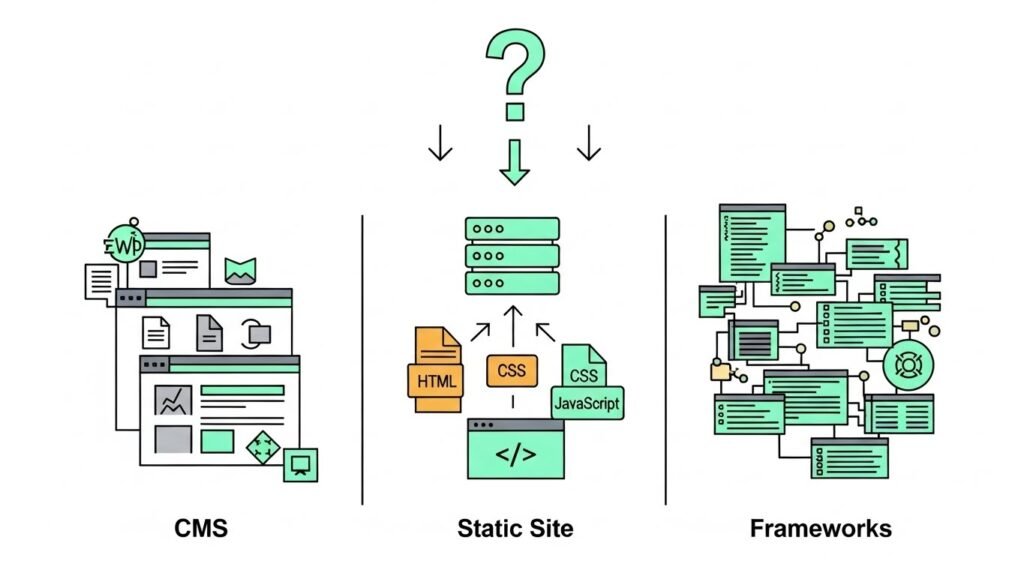
Now that you know the main characteristics of CMS, static sites, and frameworks, it’s time to evaluate which is the best option for your web project.
The choice will depend on several factors, such as:
- Project requirements: Identify whether your site needs complex dynamic functionality, database integration, advanced content management features, among others.
- Team profile: Consider your team’s level of technical experience and whether they are familiar with the different solutions.
- Available resources: Evaluate the budget, timeline, and technical team you can allocate for the project’s development and maintenance.
Generally speaking, a CMS is the best choice when you need a robust and scalable platform for content management, with advanced features and a moderate learning curve. It’s ideal for projects with dynamic requirements that need a dedicated maintenance team.
Static sites, in turn, are the most suitable option for projects with simple requirements, where performance and security are priorities. They’re a great choice for blogs, institutional sites, and portfolios, as long as there’s no need for complex dynamic features.
Frameworks stand out when you need a highly customizable and scalable solution that allows you to create robust web applications with a well-structured architecture. They’re ideal for projects with advanced requirements, where the technical team has front-end development experience.
Take Your Project to the Next Level with Kairen Studio
The choice between CMS vs static site vs frameworks is complex and defines the future of your business. Don’t leave your project’s success to chance. At Kairen Studio, we are specialists in digital solutions and can guide you in making the most strategic decision, developing the perfect solution — whether it’s a robust CMS, a high-performance static site, or a custom application built with frameworks.
Ready to build a successful web project?
Talk to our specialists today and discover how Kairen Studio can turn your idea into reality.
To deepen your knowledge, also check out: